
Mental model — Four states, not one button
Do not treat solving as merely flipping a switch. The process contains four different states:
- Prepared database: mesh, properties, constraints and loads.
- Solution definition: type of analysis, increments and results requested.
- Solution: MAPDL assembles and solves the system of equations.
- Active set: a specific state of the results file is loaded into memory.
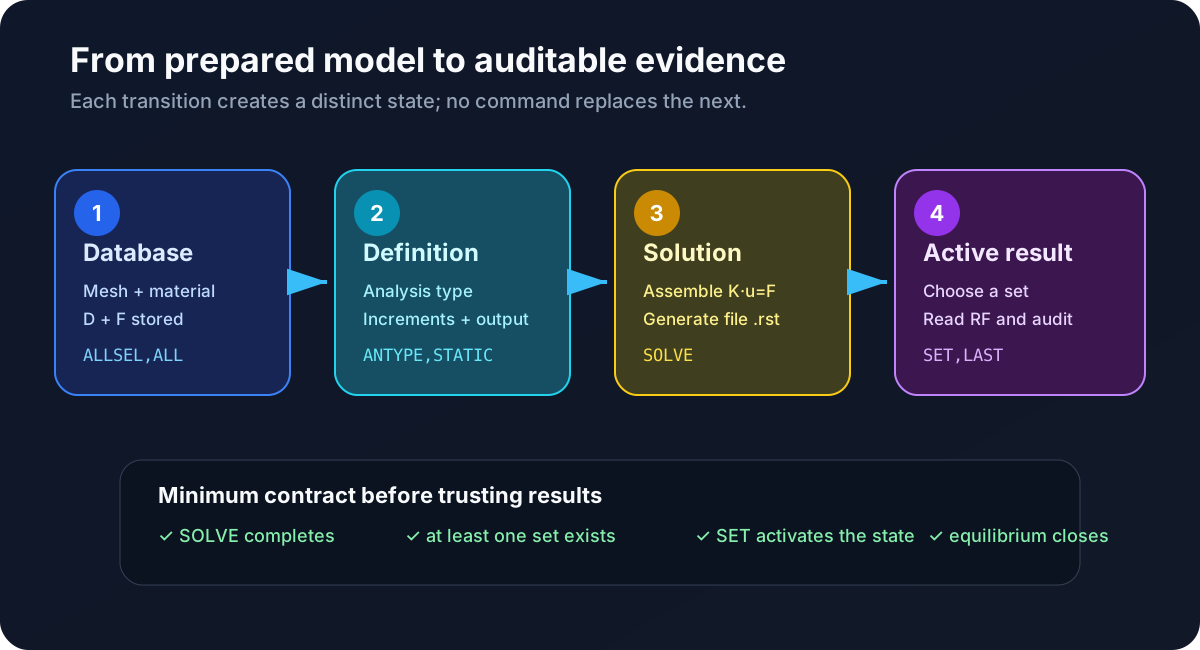
SOLVE creates results; SET chooses which result set is active.
Physics — What does “linear static” mean?
The adjective contains three decisions:
- Structural: we seek displacements and forces that satisfy equilibrium and compatibility.
- Static: we do not include inertial terms or a physical time history.
- Linear: stiffness, geometry, and constitutive behavior do not change with the response.
The idealized system can be expressed as:
[K]{u} = {F}Therefore, if we double the load without changing the model, displacements, reactions, and stresses must double. The challenge will use that proportionality as a second check.
APDL — State the hypothesis
/SOLU
ANTYPE,STATIC
NLGEOM,OFF
KBC,1
NSUBST,1
OUTRES,ALL,LASTANTYPE,STATICselects a static analysis.NLGEOM,OFFmakes linear geometry explicit.KBC,1applies the load stepwise in the single substep.NSUBST,1defines a single substep for this linear case.OUTRES,ALL,LASTsaves the requested final state.
Some options match the defaults. Writing them here is not padding; it turns the lesson assumptions into reviewable text.
Load step, substep and set
- Load step
- The load state to solve. It may represent a physical phase or a different condition.
- Substep
- Numerical increment within a load step. In nonlinear analysis it will have a decisive role.
- Result set
- Snapshot stored in the results file and recoverable later.
They are not synonyms. A load step can contain many substeps and not all of them have to have been written as sets.